
Vana ve Vana Kontrol Sistemleri
Valves and valve control systems cover the mechanical equipment that opens, closes or proportionally throttles the flow of fluids (water, steam, gas, chemicals, cryogenic liquids) in a line, together with the actuators and accessories that operate them remotely or automatically. In this group, Vanera offers butterfly, ball, knife gate, check, Y-type piston and cryogenic valves; pneumatic, electric and hydraulic actuators; and automation accessories such as positioners, limit switches and NAMUR solenoids, all from a single source. The right valve type and actuator combination are selected together based on the fluid, pressure-temperature class and automation needs.


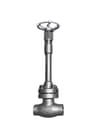
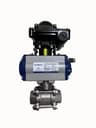


Valve Types and Applications
Butterfly valves operate via a 90° rotation of a disc in the line, offering a lightweight and economical on-off/throttling solution; they are common in large-diameter water, wastewater, HVAC and process lines. Ball valves provide fast, tight shut-off through the rotation of a sphere with a flow bore; they are preferred in general industrial, gas and high-pressure lines, and segmented-ball versions are suitable for proportional flow control.
Knife gate valves use a sharp-edged gate to cut off solid particles, sludge or fibrous fluids without clogging; they are standard in wastewater treatment, pulp and paper, and mining processes. Check valves allow fluid to flow in only one direction, protecting pumps and piping against backflow and water hammer. Y-type piston valves, with their angled body design, offer low pressure drop, and their integrated piston structure is built for a high cycle life; they are considered for aggressive chemical and vacuum applications. Cryogenic valves, with their extended bonnet design, maintain stem-seal integrity in liquefied-gas lines (oxygen, nitrogen, LNG) down to -196°C, and in globe control-valve form also allow precise flow adjustment.
Valve Control Systems: Choosing an Actuator
A valve control system consists of the actuator that opens, closes or proportionally positions the valve without manual intervention, together with the energy source that powers it. Pneumatic actuators convert compressed air into quarter-turn (90°) rotary motion; double-acting models and fail-safe spring-return models that return to a safe position on loss of air are both available. In plants without a compressed-air infrastructure, electric actuators are preferred; they run on mains or DC power, and most models can be operated manually via a handwheel during a power outage. Hydraulic actuators are used on large-diameter valves requiring very high torque and in emergency shutdown systems.
Actuator selection is based on the valve's required opening/closing torque, line pressure, ambient conditions (explosion-proof requirements, temperature) and the level of automation (local/remote control, SCADA integration). The ISO 5211 top-flange standard allows actuators to be mounted on most butterfly and ball valves without an adapter.
Positioner, Limit Switch and NAMUR Accessories
In applications requiring proportional control, a positioner compares the 4-20 mA or 0-10 V signal from the control system with the valve's actual position and regulates the air or energy supplied to the actuator so the valve stops precisely at the desired opening. Limit switch boxes electrically report the valve's fully open or fully closed position to the SCADA/PLC system; they can be mechanical or proximity-sensor type. The VDI/VDE 3845 (NAMUR) interface enables solenoid valves, limit switch boxes and positioners to be mounted quickly on pneumatic actuators, without an adapter, using standard dimensions.
The correct combination of these accessories directly determines the reliability and ease of maintenance of the valve control system in processes that require both on-off operation and continuous control.
Choosing the Right Valve and Actuator Combination
Valve selection takes into account the fluid type (clean liquid, gas, particulate-laden, corrosive, cryogenic), the line's pressure-temperature class, the connection type (threaded, flanged, wafer) and the body/sealing material. If a control function is required (continuous flow/pressure regulation), the valve characteristic must be sized together with the actuator and positioner; if on-off is sufficient, a more economical combination can be chosen. Once you share your application data (fluid, pressure, temperature, DN size, automation needs) with our team, we determine the right valve and actuator combination together.